Home » How Our State-of-the-Art Technology Improves Your Eye Care
Modern eye care looks very different from the simple chart tests many of us remember. Today’s advanced diagnostic tools allow eye doctors to see the earliest signs of disease long before vision changes occur. With this technology, we can detect subtle damage from the different types of glaucoma, monitor diabetic eye disease, and even identify early symptoms of cataracts long before they affect daily life.
At Tennessee Eye Care, our clinics across Knoxville, Harriman, Lenoir City, Morristown, and Powell use the latest imaging and diagnostic equipment to deliver precise, proactive care. Here are six state-of-the-art tools that help us protect your vision with unmatched accuracy.
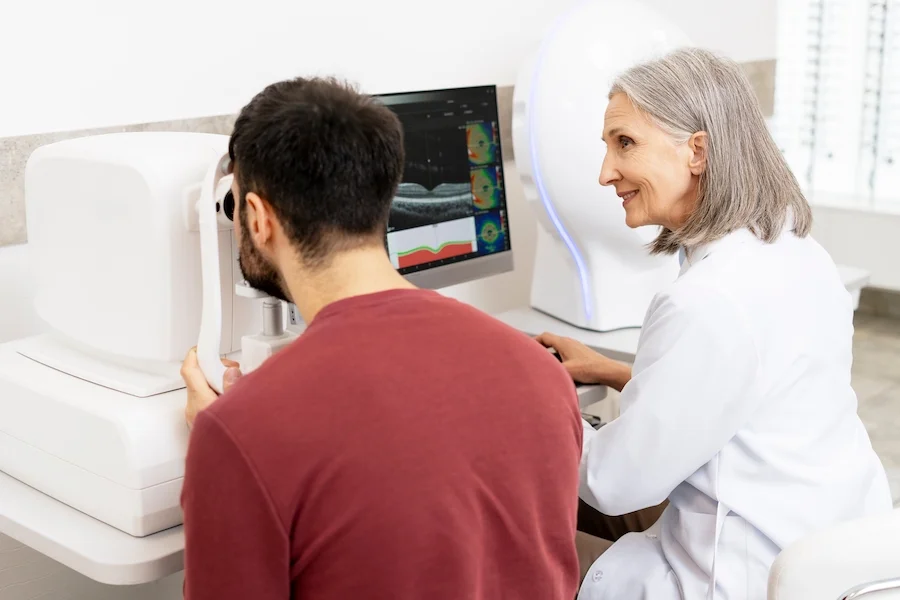
OCT is often called the “MRI of the eye” because of its ability to produce detailed, cross-sectional images of the retina and optic nerve. Using light waves, this scan reveals tiny structural changes that would be impossible to see with a standard exam.
OCT is essential for detecting early macular degeneration, diabetic retinopathy, and the subtle nerve fiber loss seen in many types of glaucoma. Early detection gives our glaucoma specialists in Tennessee the information they need to begin treatment before vision is affected.
Digital retinal imaging captures a wide, high-resolution view of the back of the eye without needing dilation in many cases. These images can be saved and compared year after year, allowing us to track even the smallest changes.
Patients often appreciate seeing the images for themselves — it helps them understand their eye health and take an active role in their care.
Your peripheral vision is just as important as your central vision. Visual field testing measures how far you can see to the sides and identifies any blind spots.
Because most types of glaucoma first affect peripheral vision, visual field testing remains a crucial tool for diagnosis and long-term monitoring. It allows us to track changes over time and determine how well treatments are working.
Although the traditional “one or two?” portion of the exam remains part of the process, automated refractors give us an incredibly accurate starting measurement.
These instruments quickly identify your refractive error and help streamline the prescription process. They also provide an objective baseline that your eye doctor in Tennessee uses before making fine adjustments.
Corneal topography creates a detailed, three-dimensional map of the front surface of your eye. This map helps us evaluate the shape, curvature, and any irregularities of the cornea.
It is essential for:
This information ensures that your lenses or surgical plan provide the best possible clarity and comfort.
Technology is powerful, but expertise matters just as much. When advanced imaging reveals concerning changes, our glaucoma specialist in Tennessee provides expert interpretation, diagnosis, and treatment planning.
This combination of state-of-the-art tools and subspecialty care offers the strongest defense against progressive eye diseases.
State-of-the-art technology has transformed the way we protect your vision. Tools like OCT, corneal topography, and visual field testing allow us to detect conditions such as the different types of glaucoma, diabetic retinopathy, and early symptoms of cataracts long before you notice vision changes. At Tennessee Eye Care, these technologies help us deliver the precise, proactive care you deserve. Contact Tennessee Eye Care today!
Not entirely. While digital retinal imaging is extremely helpful, it doesn’t fully replace dilation. A dilated exam still provides the most complete view of the retina and optic nerve.
OCT is one of the most valuable tools for diagnosing the different types of glaucoma because it measures the thickness of the optic nerve fiber layer. This often reveals damage before any vision loss occurs.
Yes. Before cataract treatment in Tennessee, advanced imaging helps measure the eye and select the ideal replacement lens (IOL) for the clearest postoperative vision.