
Vision is a vital part of our daily lives, influencing how we interact with the world around us. One of the most common terms associated with vision quality is “20/20 vision.” This term is often considered synonymous with perfect vision, but what does it actually mean? This article will explore the concept of 20/20 vision, delve into the difference between sight and vision, and discuss its implications in our daily lives.
The Short Answer
20/20 vision means that standing 20 feet from an eye chart, you can read what a person with normal eyesight can read from 20 feet. It describes normal sharpness of vision at a distance. It isn’t “perfect” vision: some people see better than 20/20, and the measurement says nothing about peripheral vision, depth perception, color vision, focusing up close, or the health of your eyes.
What the Two Numbers Mean
The first number is how far you stand from the chart, which in the US is 20 feet. The second number is the distance from which a person with normal vision could read the smallest line you read correctly.
- 20/20: you read at 20 feet what a person with normal vision reads at 20 feet. This is normal visual acuity.
- 20/15 or 20/10: sharper than normal. You read at 20 feet what most people need to stand 15 or 10 feet away to read.
- 20/40: you need to be at 20 feet to read what a person with normal vision can read from 40 feet. Many US states use 20/40 as the minimum for driving without corrective lenses, but rules vary, so check your state’s requirements.
- 20/200: you need to be at 20 feet to read what normal vision reads from 200 feet. In the US, vision of 20/200 or worse in the better eye, even with glasses or contacts, is the threshold for legal blindness.
Most people who don’t reach 20/20 can get there with glasses or contact lenses. A score like 20/40 usually reflects a focusing problem the right prescription can correct, not a problem with the health of the eye.
Understanding 20/20 Vision
20/20 vision is a term used to express normal visual acuity (the clarity or sharpness of vision) measured at a distance of 20 feet. If you have 20/20 vision, you can see clearly at 20 feet what should normally be seen at that distance.
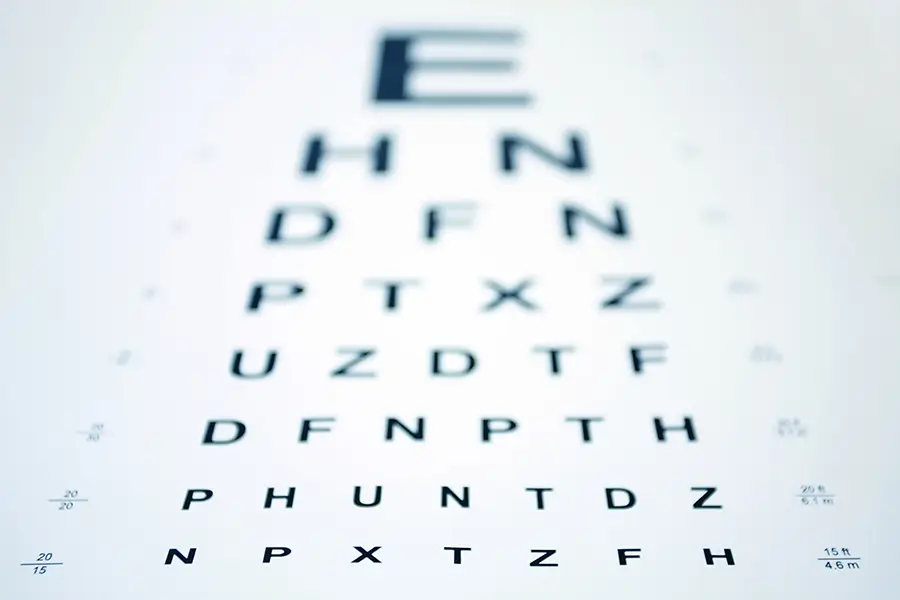
The standard tool used to measure visual acuity is the Snellen chart, which was developed by Dutch ophthalmologist Herman Snellen in the 1860s. This chart displays letters of progressively smaller size. When you undergo a visual acuity test, you are asked to read the Snellen chart from a distance of 20 feet. The smallest row of letters that you can read accurately determines your visual acuity. If the smallest letters you can read are in the “20” line, you have 20/20 vision.
It’s a common misconception that 20/20 vision means perfect vision. However, visual acuity is just one aspect of vision. Other factors, such as peripheral awareness, eye coordination, depth perception, focusing ability, and color vision, also contribute to your overall visual ability.
Beyond 20/20: Other Aspects of Vision
Having 20/20 sight doesn’t guarantee perfect visual performance. Here are other vital components of vision:
Peripheral Vision
This refers to your ability to see objects and movement outside the direct line of vision. It’s crucial for activities like driving, where you need to be aware of your surroundings.
Depth Perception
Depth perception allows you to judge the distance and spatial relationship of objects. It’s essential for tasks like driving, playing sports, and simply navigating through space.
Eye Coordination
This involves the ability of both eyes to work together seamlessly. Good eye coordination ensures comfortable and efficient reading, writing, and participation in sports.
Color Vision
This is the ability to distinguish between different colors. While not as crucial as some other aspects of vision, it enriches our experience of the world and can be important in specific occupations.
Focusing Ability
This refers to the eyes’ ability to quickly and accurately adjust focus at different distances, an essential aspect of clear vision.
Conditions Affecting Visual Acuity
Several conditions can affect visual acuity:
Myopia (Nearsightedness)
This is when distant objects appear blurry because the eye’s shape causes light rays to bend (refract) incorrectly, focusing images in front of the retina instead of on it. Read more in our guide to nearsightedness.
Hyperopia (Farsightedness)
This occurs when the eye is shorter than normal, causing near objects to be blurry, as images are focused behind the retina. See the symptoms and treatment of farsightedness.
Astigmatism
This is caused by an irregularly shaped cornea, leading to blurred vision at any distance.
Presbyopia
This age-related condition affects the eye’s ability to focus on close objects. It’s why many people with 20/20 distance vision start needing readers in their 40s; see do I need reading glasses?
Eye Exams: More Than Just Acuity Tests
Comprehensive eye exams assess more than just visual acuity. They examine the health of your eyes and evaluate different aspects of your vision. Regular eye exams are crucial in detecting eye conditions early and maintaining overall eye health. Conditions such as glaucoma can damage vision long before they affect your 20/20 score, which is why an eye chart alone isn’t enough. Here’s what happens in an eye exam.
Our expert team is dedicated to ensuring the health and clarity of your vision by conducting thorough eye exams tailored to your individual needs. Trust us to help maintain your eyesight throughout your life. Find a Tennessee Eye Care location near you to schedule an exam.